Why I am talking about a setting that barely matters
Honesty matters to me, so I want to be clear about the Reconstruction Filter: in hi-res playback, it is usually close to irrelevant. That is not a bug and it is not a hidden secret - it is simply how the math works when the sample rate gets very high.
What the filter actually does
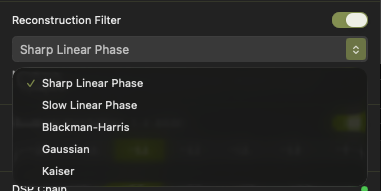
The Reconstruction Filter is a 256-tap windowed-sinc FIR filter with a cutoff that scales with the source sample rate. At 44.1 kHz, it sits right near the top of the audible range, which is where filter behavior can still matter. But at 96 kHz or 192 kHz, the whole transition band shifts far above human hearing.
That is why the different filter modes - Sharp Linear Phase, Slow Linear Phase, Blackman-Harris, Gaussian, Kaiser - become mostly academic with hi-res material. Yes, they differ in rolloff and ringing behavior. No, that does not mean they are changing the sound in any meaningful way when the cutoff ends up at 86 kHz on a 192 kHz file.
Why the DAC argument is backwards
I still see the claim that the DAC already fixes everything anyway. It does not work like that. A DACs internal reconstruction filter does not cancel a digital low-pass filter upstream. They operate in series, and their transfer functions multiply.
This is exactly why software upsamplers try to move the DAC filter out of the way in the first place. They feed the DAC a much higher sample rate so the DACs own filter becomes less relevant, while the software filter does the important work closer to the original Nyquist boundary.
Zenteek does not upsample here. It simply follows the sample rate of the file. If you play a 192 kHz track, the filter moves with it. That is all.
| Sample Rate | Cutoff | On the Spectrum |
|---|---|---|
| 44.1 kHz | ~19.8 kHz | Upper edge of human hearing - relevant |
| 96 kHz | ~43.2 kHz | Inaudible - not relevant |
| 192 kHz | ~86.4 kHz | Inaudible - not relevant |
The one small real benefit at hi-res
There is one practical reason to keep it around. At 176 kHz and above, the harmonic processors - Exciter, Vitalizer, and Saturation - can run without extra oversampling because there is enough ultrasonic headroom already available. That means some generated energy can reach the top end of the spectrum.
The Reconstruction Filter trims the highest ultrasonic content before it reaches the DAC. That can slightly reduce the chance of ugly intermodulation in downstream analog gear. It is a housekeeping measure, not a secret tone control, and definitely not a magic polish button.
And once aliasing has already folded back into the audible range, no downstream filter can undo it. Not mine, not the DAC’s, not anyone else’s.
What I want you to take away
If you listen mostly to 44.1 kHz material, the filter choice is genuinely relevant. If you listen mostly to hi-res files, you can treat the Reconstruction Filter as an almost inaudible technical safeguard and leave it on without worrying about it.
I could have called this “warmth” or “musicality” - I did not. The truth is more boring, and more useful: at hi-res, the Reconstruction Filter barely does anything audible, and that is exactly the point. It is fundamentally protective rather than additive.